Dronescapes
Drone videos with human-annotated semantic segmentation, SfM depth and surface normals, recorded over several scenes in Romania and Norway.
RGB video, 8-class semantics, SfM depth, Surface normals, Optical flow, Edges
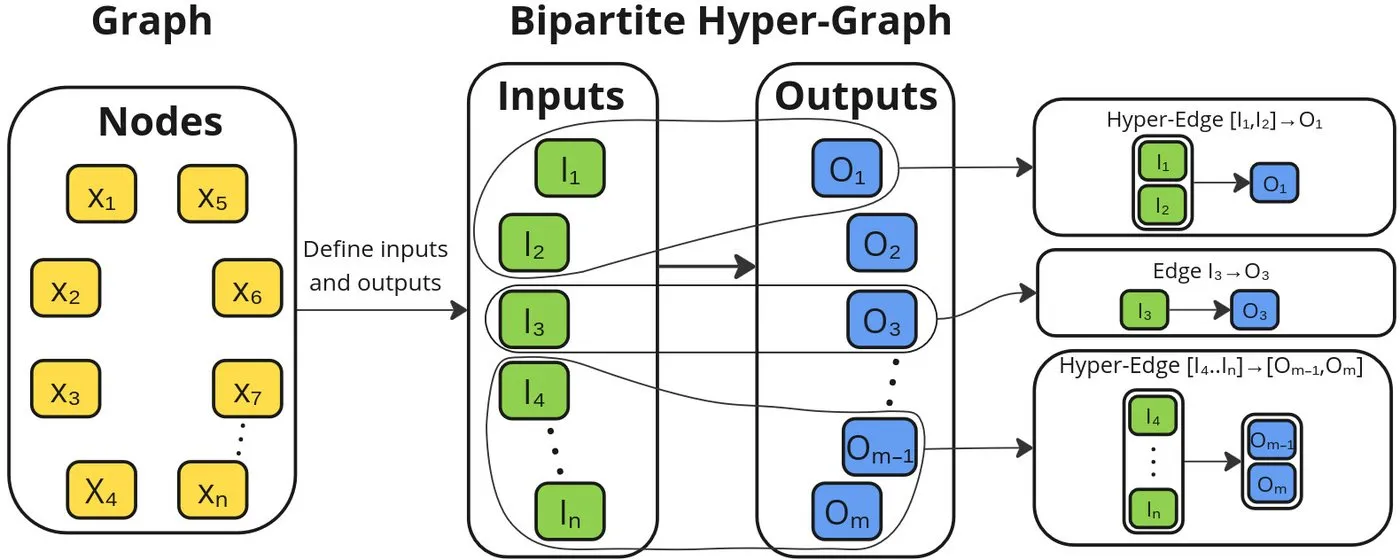
A scene can be described by its semantics, depth, surface normals, edges or optical flow. We treat each of these as a node in a graph, or a hypergraph, and train a neural network for every edge to predict one representation from another. After a short supervised phase, each edge is retrained on pseudo-labels taken from the agreement of all the paths that reach the same node, so the system keeps improving on new video that nobody labelled.
The idea started with Neural Graph Consensus (AAAI 2021) and Iterative Consensus Shift (BMVC 2021). It continued with self-supervised hypergraphs on the Dronescapes dataset (ICCV 2023 Workshops), probabilistic hypergraphs built from randomly masked autoencoders (Neurocomputing 2026), and a pipeline that generates the extra modalities for a video automatically.
Drone videos with human-annotated semantic segmentation, SfM depth and surface normals, recorded over several scenes in Romania and Norway.
RGB video, 8-class semantics, SfM depth, Surface normals, Optical flow, Edges
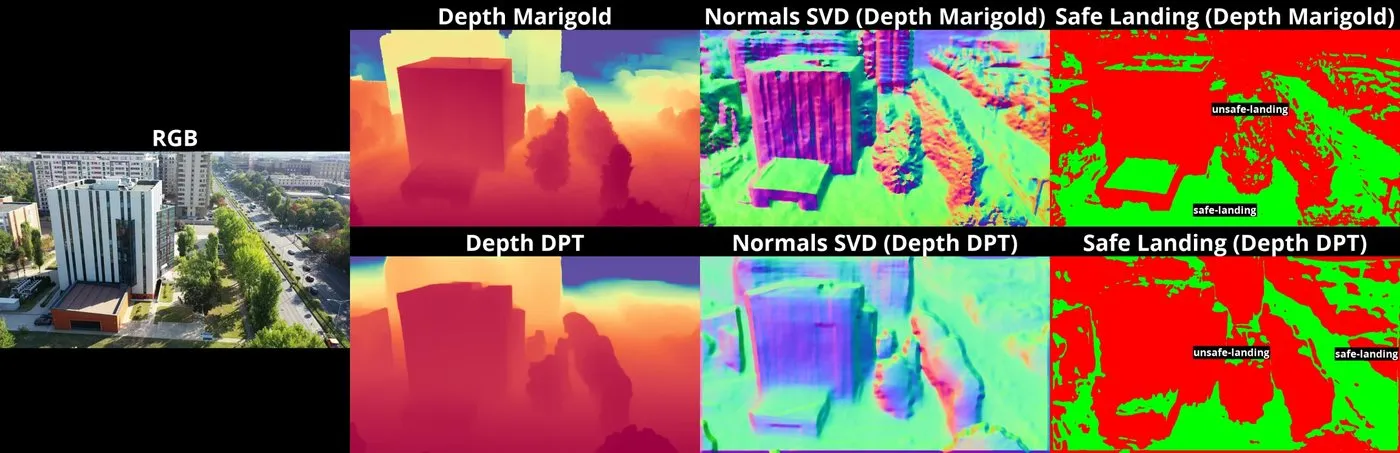
Dronescapes with extra modalities produced by pretrained expert models through the Video Representations Extractor (VRE).
RGB video, Expert-generated modalities, Semantics, Depth, Normals
Multi-task scene data used in the Neural Graph Consensus experiments (AAAI 2021). The code is at gitlab.com/mihaicristianpirvu/cycleconcepts.
RGB, Depth, Semantics, Normals, Camera pose
Neurocomputing, 2026
The computer vision domain has greatly benefited from an abundance of data across many modalities to improve on various visual tasks. Recently, there has been a lot of focus on self-supervised pre-training methods through Masked Autoencoders (MAE) \cite{he2022masked,bachmann2022multimae}, usually used as a first step before optimizing for a downstream task, such as classification or regression. This is very useful as it doesn’t require any manually labeled data. In this work, we introduce Probabilistic Hyper-Graphs using Masked Autoencoders (PHG-MAE): a novel model that unifies the classical work on neural graphs \cite{leordeanu2021semi} with the modern approach of masked autoencoders under a common theoretical framework. Through random masking of entire modalities, not just patches, the model samples from the distribution of hyper-edges on each forward pass. Additionally, the model adapts the standard MAE algorithm by combining pre-training and fine-tuning into a single training loop. Moreover, our approach enables the creation of inference-time ensembles which, through aggregation, boost the final prediction performance and consistency. Lastly, we show that we can apply knowledge distillation on top of the ensembles with little loss in performance, even with models that have fewer than 1M parameters. While our work mostly focuses on outdoor UAV scenes that contain multiple world interpretations and modalities, the same steps can be followed in other similar domains, such as autonomous driving or indoor robotics. In order to streamline the process of integrating external pre-trained experts for computer vision multi-modal multi-task learning (MTL) scenarios, we developed a data-pipeline software. Using this tool, we have created and released a fully-automated extension of the Dronescapes dataset. All the technical details, code and reproduction steps are publicly released.
arXiv preprint, 2025
The real-world is inherently multi-modal at its core. Our tools observe and take snapshots of it, in digital form, such as videos or sounds, however much of it is lost. Similarly for actions and information passing between humans, languages are used as a written form of communication. Traditionally, Machine Learning models have been unimodal (i.e. rgb -> semantic or text -> sentiment_class). Recent trends go towards bi-modality, where images and text are learned together, however, in order to truly understand the world, we need to integrate all these independent modalities. In this work we try to combine as many visual modalities as we can using little to no human supervision. In order to do this, we use pre-trained experts and procedural combinations between them on top of raw videos using a fully autonomous data-pipeline, which we also open-source. We then make use of PHG-MAE, a model specifically designed to leverage multi-modal data. We show that this model which was efficiently distilled into a low-parameter (<1M) can have competitive results compared to models of ~300M parameters. We deploy this model and analyze the use-case of real-time semantic segmentation from handheld devices or webcams on commodity hardware. Finally, we deploy other off-the-shelf models using the same framework, such as DPT for near real-time depth estimation.
arXiv preprint, 2025
Humans effortlessly identify objects by leveraging a rich understanding of the surrounding scene, including spatial relationships, material properties, and the co-occurrence of other objects. In contrast, most computational object recognition systems operate on isolated image regions, devoid of meaning in isolation, thus ignoring this vital contextual information. This paper argues for the critical role of context and introduces a novel framework for contextual object classification. We first construct a Geo-Semantic Contextual Graph (GSCG) from a single monocular image. This rich, structured representation is built by integrating a metric depth estimator with a unified panoptic and material segmentation model. The GSCG encodes objects as nodes with detailed geometric, chromatic, and material attributes, and their spatial relationships as edges. This explicit graph structure makes the model’s reasoning process inherently interpretable. We then propose a specialized graph-based classifier that aggregates features from a target object, its immediate neighbors, and the global scene context to predict its class. Through extensive ablation studies, we demonstrate that our context-aware model achieves a classification accuracy of 73.4%, dramatically outperforming context-agnostic versions (as low as 38.4%). Furthermore, our GSCG-based approach significantly surpasses strong baselines, including fine-tuned ResNet models (max 53.5%) and a state-of-the-art multimodal Large Language Model (LLM), Llama 4 Scout, which, even when given the full image alongside a detailed description of objects, maxes out at 42.3%. These results on COCO 2017 train/val splits highlight the superiority of explicitly structured and interpretable context for object recognition tasks.
arXiv preprint, 2024
There is an increasing number of real-world problems in computer vision and machine learning requiring to take into consideration multiple interpretation layers (modalities or views) of the world and learn how they relate to each other. For example, in the case of Earth Observations from satellite data, it is important to be able to predict one observation layer (e.g. vegetation index) from other layers (e.g. water vapor, snow cover, temperature etc), in order to best understand how the Earth System functions and also be able to reliably predict information for one layer when the data is missing (e.g. due to measurement failure or error).
Proceedings of the IEEE/CVF International Conference on Computer Vision Workshops (ICCVW), 2023, LIMIT workshop
We present a method for learning multiple scene representations given a small labeled set, by exploiting the relationships between such representations in the form of a multi-task hypergraph. We also show how we can use the hypergraph to improve a powerful pretrained VisTransformer model without any additional labeled data. In our hypergraph, each node is an interpretation layer (e.g., depth or segmentation) of the scene. Within each hyperedge, one or several input nodes predict the layer at the output node. Thus, each node could be an input node in some hyperedges and an output node in others. In this way, multiple paths can reach the same node, to form ensembles from which we obtain robust pseudolabels, which allow self-supervised learning in the hypergraph. We test different ensemble models and different types of hyperedges and show superior performance to other multi-task graph models in the field. We also introduce Dronescapes, a large video dataset captured with UAVs in different complex real-world scenes, with multiple representations, suitable for multi-task learning.
Proceedings of the British Machine Vision Conference (BMVC), 2021
The human ability to synchronize the feedback from all their senses inspired recent works in multi-task and multi-modal learning. While these works rely on expensive supervision, our multi-task graph requires only pseudo-labels from expert models. Every graph node represents a task, and each edge learns between tasks transformations. Once initialized, the graph learns self-supervised, based on a novel consensus shift algorithm that intelligently exploits the agreement between graph pathways to generate new pseudo-labels for the next learning cycle. We demonstrate significant improvement from one unsupervised learning iteration to the next, outperforming related recent methods in extensive multi-task learning experiments on two challenging datasets. Our code is available at https://github.com/bit-ml/cshift.
Proceedings of the AAAI Conference on Artificial Intelligence (AAAI), 2021
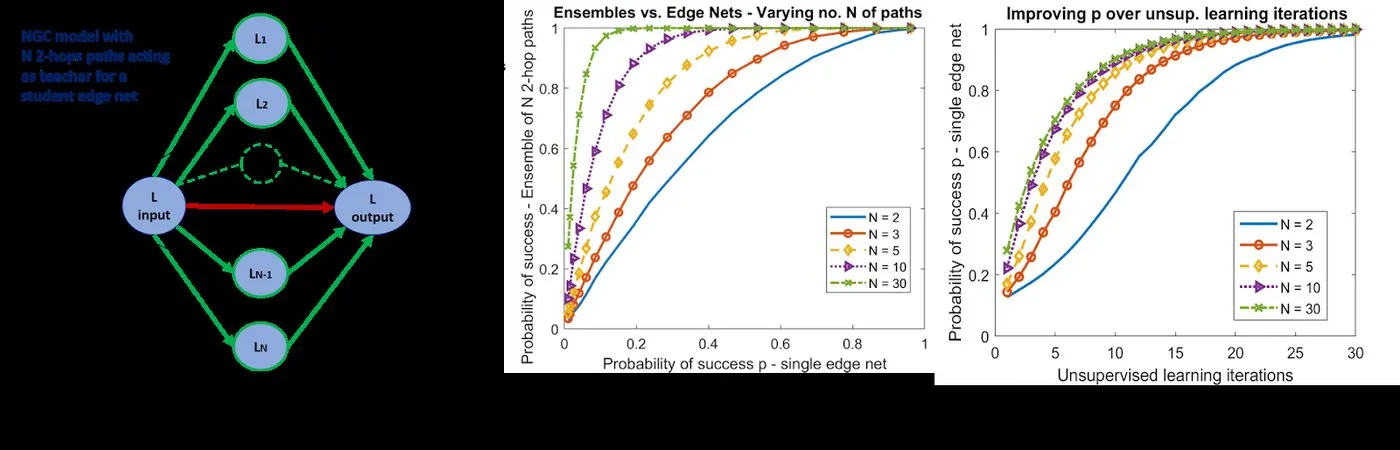
We address the challenging problem of semi-supervised learning in the context of multiple visual interpretations of the world by finding consensus in a graph of neural networks. Each graph node is a scene interpretation layer, while each edge is a deep net that transforms one layer at one node into another from a different node. During the supervised phase edge networks are trained independently. During the next unsupervised stage edge nets are trained on the pseudo-ground truth provided by consensus among multiple paths that reach the nets’ start and end nodes. These paths act as ensemble teachers for any given edge and strong consensus is used for high-confidence supervisory signal. The unsupervised learning process is repeated over several generations, in which each edge becomes a “student” and also part of different ensemble “teachers” for training other students. By optimizing such consensus between different paths, the graph reaches consistency and robustness over multiple interpretations and generations, in the face of unknown labels. We give theoretical justifications of the proposed idea and validate it on a large dataset. We show how prediction of different representations such as depth, semantic segmentation, surface normals and pose from RGB input could be effectively learned through self-supervised consensus in our graph. We also compare to state-of-the-art methods for multi-task and semi-supervised learning and show superior performance.
Proceedings of the IEEE International Conference on Image Processing (ICIP), 2019
We propose Shift R-CNN, a hybrid model for monocular 3D object detection, which combines deep learning with the power of geometry. We adapt a Faster R-CNN network for regressing initial 2D and 3D object properties and combine it with a least squares solution for the inverse 2D to 3D geometric mapping problem, using the camera projection matrix. The closed-form solution of the mathematical system, along with the initial output of the adapted Faster R-CNN are then passed through a final ShiftNet network that refines the result using our newly proposed Volume Displacement Loss. Our novel, geometrically constrained deep learning approach to monocular 3D object detection obtains top results on KITTI 3D Object Detection Benchmark, being the best among all monocular methods that do not use any pre-trained network for depth estimation.